Thursday, 19 December 2013

Medea

Medea
In Medea I played Jason, the leading male role. Jason is Medeas husband who betrays her by leaving her and their two sons to be with the Royal Princess. The betrayal from Jason causes Medea to go insane, the audience would seem, she cunjours up a plan to get back at Jason for what he done. Although deep down she still loves Jason, she wants to get him where it hurts most... his heart. Medea, in her crazy state, plans to kill the Princess by poisoning a dress and crown she had her children deliver to the Royal Palace. The Princess died once she put the dress on, along came her father Creon The King and sadly the poison leached to his body and killed him too. She then had been driven by new levels of insanity and planned to kill her own children in order to get full revenge on Jason. She kills them both and that's the whole story simplified.
I was happy to play Jason because I've never had the opportunity to play off a character who is driven by anger and full of mixed emotions between the love of his children and hatred for his ex-wife. I felt confident with doing something new and I feel I had to open up some new skills which I hadn't been very familiar with to make my character realistic by using my own emotions to portray Jason's character. By using my own emotions I was able to put myself into Jason's position and genuinely felt a bit sorry for myself and aim my anger at Medea. I think I was cast as Jason to give me a challenge and I was happy to accept the challenge and play it off the way I felt it would work.
I found it challenging having long monologues for dialogue and at times I didn't think I'd remember my lines but I managed to remember my lines no matter how many lines I was given.
My strongest scene was in my first appearance as Jason with Medea as we were arguing. Polly and I began closer together on the proskeniun and the stronger the arguement became the further away from each other and I think us doing that gave a more angry mood and we did this for that reason.
The opening sequence with the Nurse's monologue we used as a chorus peice with us all working in unison and each movement represented the words that were being said. The line "anywhere else you were a foreigner" says a lot about Greek history, in ancient Greek times anyone who didn't speak the native tongue was called a barbarian which is a foreigner and that's what Medea was seen as.
I chose to use my normal voice to characterize Jason as it didn't seem necessary to put on any accent whereas others in Medea had decided to use a posh/well spoken accent which I thought was preferrable in an Elizabethn play such as those written by Shakespeare. I myself think I already have a well spoken voice and chose to keep it the same, I think doing this kept a realistic portrayal of my character and the play.
I chose to wear a grey blazer and trousers to connote the bad time Jason is going through with his ex-wife going crazy and still lingering in his life. Then to add injury to insult she kills his fiance, his future father in law and his two children. His life couldn't get much worse and so the grey shows off his bad times which are often referred to as 'grey times'. And usually you'd have a man with his shirt done up to the top button but as my charcter was under a lot of stress it was sensible to have by shirt undone. 
A challenge for me was portraying a man who mistreated his wife and ran off with another because I myself have never had that experience so it was all about me really stepping into the shoes of a man who has little morals. But then I also had to make sure I wasn't too far expressed in a way that Jason hates Medea because that wasn't the case he'd just fallen for another woman in order to gain publicity for his name. So I challenged myself with this role, and I also had to step into the shoes of a man who loses his wife, father in law and two children all in a short space of time, and that my ex wife killed them all. So that was quite a challenge because again I've never had that experience in my life but I felt that by using my own skills I managed to portray Jason in a way that was clear to the audience. 


Tuesday, 17 December 2013

Greek Theatre and History

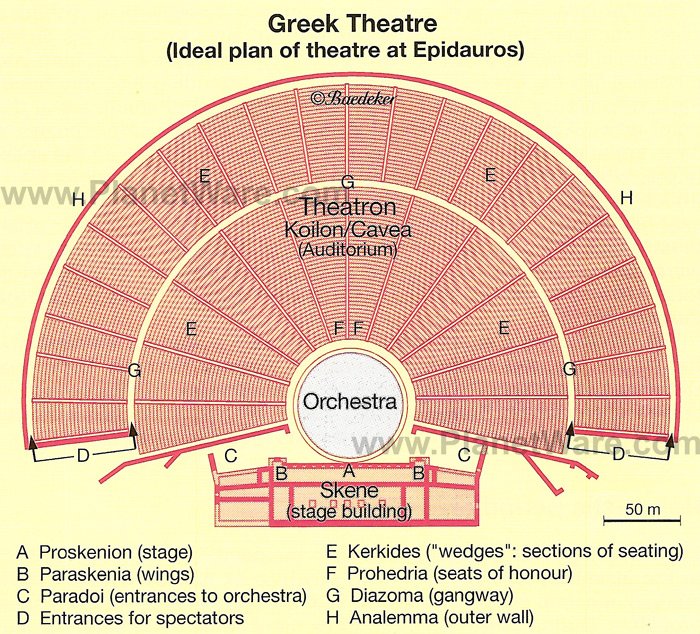
Greek Theatre shape

Greek Theatre

Ancient Greek History
Ancient Greece was a number of cities- 
Athens: No other city has contributed more to civilisation of mankind than Athens. It's the place where humanism and democracy were born. The intellectual light that Athens created will always be alive.
Sikyon: Two of the great artists of sculpture were born here. Sikyon's importance was great and it is little known, maybe not at all, that the birth of tragedy was founded here in the 7th century BC.
Corinth: The home of Sisyphos and the great hero Bellerophon. It's one of the oldest Greek City-States and among the most important ones.
Sparta:The city state occupying the central finger of Peleponnese, was the greatest military power of Greece and played a catalytic role in their history.
Thebes: The birthplace of the legendary hero Herakles and men of importance like Pindar and Epameinondas, played a major role in the affairs of Greece.
Argos:During the 7th century BC, at the times of the tyrant Pheidon, who introduced weights and measures in Peloponnese and according to Aristotle he invented coinage, Argos reached its highest power.
Mykenae: Founded by the hero Perseus and becoming favorite residence of Pelops and his descendants, it became the most important city of Greece at the times of the king Agamemnon.
Delphi: During the 7th century BC, when the barbarian cult of Dionysos had been introduced in Greece, endangering to wipe out the values and traditions and send Hellenes in barbaric stages, it was Delphi that saved Greece by ingeniously introducing Dionysos, with the qualities of Apollo.
Olympia: Every four years a pan-Hellenic truce was announced and people from all over Hellas gathered at Olympia, in order to compete and attend the Games. The prize for the winner was the "kotinos", a garland made from wild olive tree.

In Greece the language they speak is Greek, obviously, but there were some folk that didn't speak the native language and these people were known as Barbarians because they sounded like sheep - In Medea in the opening sequence there reads the line "Anywhere else you're a foreigner" which suggests that Medea is a foreigner and is a barbarian.
The Greek War of Independence, also known as the Greek Revolutionwas a successful war of independence waged by the Greek revolutionaries between 1821 and 1832, with later assistance from Russia, the United Kingdom, France, and several other European powers against the Ottoman Empire, who were assisted by their vassals, the Eyalet of Egypt, and partly by the Beylik of Tunis.
After the war the Greeks put on plays about peace and wealth and used these as themes to bring back the peace and wealth suffered from the war in their country.

The Pythia, commonly known as the Oracle of Delphi, was the priestess at the Temple of Apollo at Delphi, located on the slopes of Mount Parnassus, beneath the Castalian Spring. The Oracle was always half-baked and was corrupt, promising local citizens their most desired wishes taking their money and never doing as they asked.


Greek Theatre vocabularySkene - Scene/Background
Proskenion - Stage
Hypocrite - Actor
Orchestra - Dancing place
Katharsis - The purification and the purgation of emotions especially pity and fear through art
Choregos - Wealthy producerof the play

ThemesRevenge
Women
Foreigner

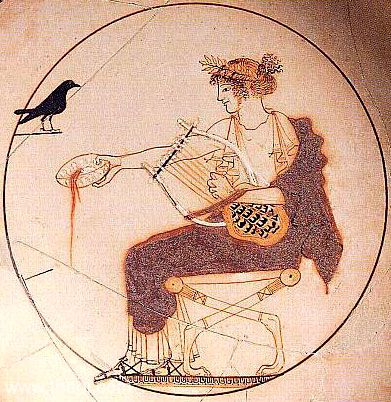
Apollo, god of music, with raven & lyre | Greek vase, Athenian red figure white-ground kylix
Apollo, god of music, Athenian red-figure kylix
C5th B.C., Archaeological Museum of Delphi


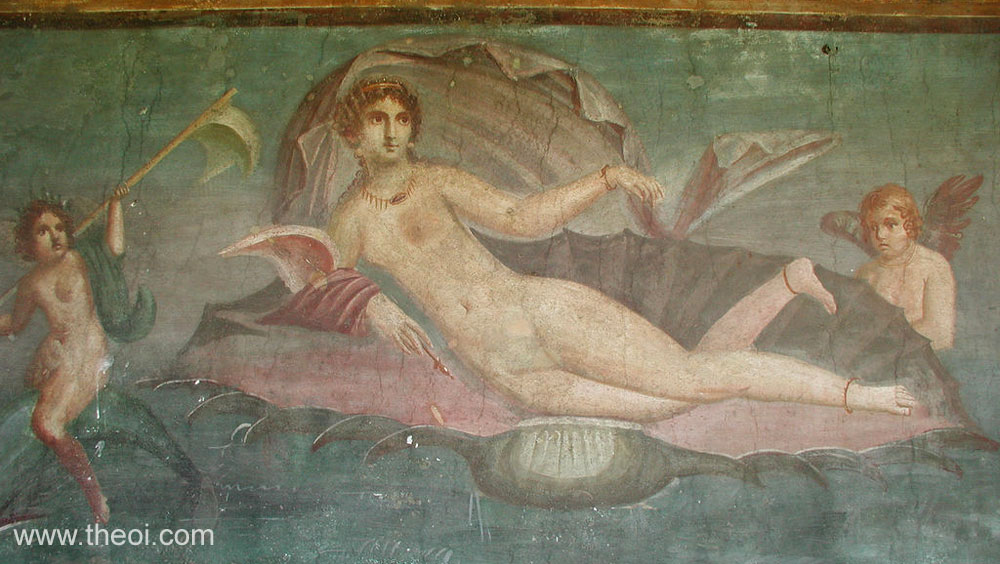
Birth of Venus (Aphrodite) with Cupid (Eros) & a Nereid | Roman fresco Pompeii
Aphrodite (Venus), goddess of love, Roman fresco from
Pompeii C1st A.D., Archaeological Museum of Naples

Tuesday, 12 November 2013

Comparison table task
 
The Tempest
Staging
Our stage for The Tempest was set up in the 'thrust' style which is when the audience is set up on 3 sides like so.
AudienceOur audience just consisted of our classmates who were also in the performance so there wasn't a large capacity.
Production valuesProps:there weren't many props used, we used chairs on stage, a gun and a bottle of some sort of alcohol. Costumes: My costume was made up of a grey blazer, a grey hat, a bandana, white t-shirt and blue jeans.
Sound: In the opening sequence we used a peice of music by skrillex to add the effect and all changed dynamically when the line "oh my god" was screamed in the music. This peice of music was used again in a section with Medea speaking to the people on the floor.
Lighting: To show that there is a storm, we used blue flashing lights to symbolize lightning and also purple flashing lights for the section with Meda speaking to the people on the floor.
Political significanceConflict in scenes between different characters. Caliban seen as a black man and used as a slave.
Cultural significanceOur production of The Tempest was certainly not typical of original and other Shakespearean plays because we modernized it by adding modern music to make more affect to the scenes. Our costumes as well weren't typical for a Shakespearean play because in the Elizabethan times their clothing was very different to what we wear now. However, we could have bought/hired Elizabethan costumes had we wanted to make our play more typical of the original play of The Tempest.

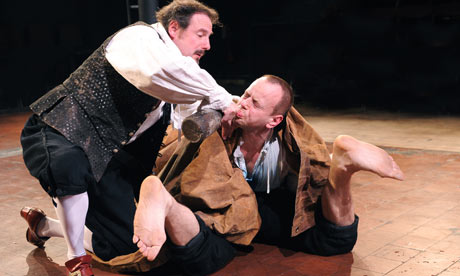
This is a picture from a performance of The Tempest in it's original form.
Social significance

Modern Shakespeare
Staging
Audience
Production values
Political significance
Cultural significance
Social significance
 
Medea 5th Century BC, Greece
Staging- Ampitheatre seating 5000 with a round orchestra.
Audience
Production values
Political significance
Cultural significance
Social significance
 
Modern Greek Theatre(Our Medea)
Staging- Studio theatre with 130 seats in triangle shape.
Audience
Production values
Political significance
Cultural significance
Social significance


Wednesday, 6 November 2013

05/11/2013

Our lesson began with two games that developed our chorus work which both included communication without speaking and also focus. The first game was called 'Walk around stop' and the aim of the game is in the name really. Individually we all walked around the space avoiding to bump into one another by moving in straight lines. There's a ranking of walking speed from 0-5(0 meaning STOP and 5 being the fastest) and without speaking we had to all walk at the same speed from 0-5 and 5-0 in sync.
Afterwards we played 'School of fish' which is a choral technique where you have a group of people and together all move forward in the same direction and at the same speed. This effect looks really good from a birds eye view and quite coincidentally looks like a 'school of fish' in the sea.

In the second half of the lesson we refreshed our brains on what we worked on in the last lesson. We went back into our groups which we were to choreograph movements for the opening sequence of the nurse's speech. As a group we had to teach our movements to the entire class. Everyone showed the class what they had to put into this section and through this link http://www.youtube.com/watch?v=uaY-xLMlaCI&sns=em you can see what the piece looks like so far. In this run through we applied the chorus game exercises to this peice because it's a chorus peice. The games were exercises for individuals and an entire group and in the opening sequence of the boat and all the Medeas the focus is on everyone on stage and spotlights Medea.

Friday, 1 November 2013

Tempest - classical theatre unit

The Tempest: review on my performance

My character was Trinculo - A consistently drunken jester, who is a servant of Alonso's, and brought ashore in the shipwreck. He is a dull fool mostly, not capable of any real action, and providing a good deal of comic relief.

My costume - grey hat, grey blazer, blue bandana scarf, white t-shirt and blue jeans.

At first I tried this on as a joke but Adrian said it'd look good and suit my character so that was the inspiration for my costume.

In the early stages of rehearsing the scenes I couldn't find a voice for me to develop for my character. Adrian suggested I take up a high pitched voice due to my character being a comical one. The effect of the high pitched voice makes it funny because it's unusual for a grown man to have a high pitched voice. This decision paid off well as it got a handful of laughs from the audience(students in our class).
After watching the performance back over on video, I noticed that my speech wasn't always clear. I feel that because I was having to speak in a high pitched voice it caused me to speed up the tempo when I was speaking. I do feel that it's something that I must improve but I'll work on it. 


I felt that my strongest scene was in my second scene where Ariel interferes in a conversation between Stephano and Caliban and she pops up, unseen, and says "thou liest" towards Calliban and they both think that Trinculo is saying these words and so he is getting blamed. In this scene I think my characterization was much greater because my movement and speaking was clear rather than my first scene, there's also a little bit of physical theatre, when I throw my chair and Maisie(Stephano) kneed me in the ribs.

I feel my overall performance was well done as I done what I was asked to do though I could improve on my tone of voice.


Theatre time - line

534 BC - Drama AS competition

550-630 BC - Greek Theatre

900-1500 - Mystery plays and morality plays

1500-1700 - Comedia dell'arte/Satire/Slapstick

1550-1642 - Revenge tragedy and Elizabethan theatre

1642-1660 - Puritans ban theatre

1660-1800 - Restoration comedy

1800-1880 - Melodrama

1880-1940 - Realism/Naturalism

1952-1965 - Theatre of the absurd

1976 - National theatre opens
Elizabethan theatre

There was the nobility/gentry and the lower classes. However, many merchants and town folk were becoming so wealthy via trade and services that they could ape the manners of the upper class and enjoy many of the same luxuries.

Elizabethans were very superstitious and attracted to the fanciful and the occult. Charms and amulets were often worn. Signs and omens were taken seriously. Anything out of the ordinary could be taken as an omen - it was bad luck to hear a toad croak or an owl hoot. Many things could signal on impending death, like blood dripping three times from a nose, a red or bloody moon. Remedies were often based on folk tradition - tumors could be removed by stroking with a corpse's hand. Feeding on snakes could restore your youth.

Both public and private schools were becoming more and more available for the lower classes and those who could not afford private tutors.

In cities and towns, homes were usually built of timber and plaster. The merchant's shop was in the front part of the house on the ground level, rooms opened into one another and weren't the modern conventions of doors opening on a hallway.

Elizabethan folk loved a good festival. There were regular fairs called ales, at which ale (the staple beverage of the time) was consumed heavily.
Elizabethan folk also loved group sports such as football. Elizabethan's also loved music, both instrumental and vocal, and dancing. The higher orders and those trying to imitate them like upper middle class were fond of Italian and French dances.

Elizabethan plays:
-Hamlet
-Macbeth
-The Tempest
-King John
-Richard II
-The Spanish Tragedy
-The Jew of Malta