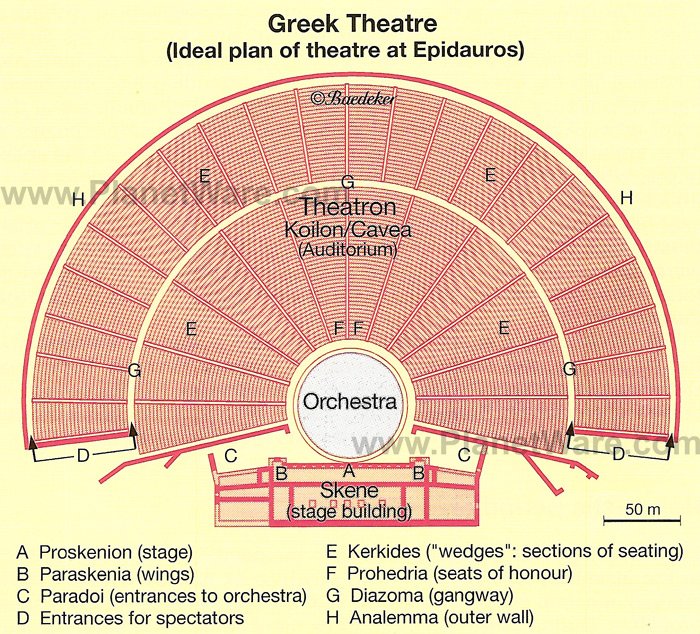
Greek Theatre shape
Ancient Greek History
Ancient Greece was a number of cities-
Athens: No other city has contributed more to civilisation of mankind than Athens. It's the place where humanism and democracy were born. The intellectual light that Athens created will always be alive.
Sikyon: Two of the great artists of sculpture were born here. Sikyon's importance was great and it is little known, maybe not at all, that the birth of tragedy was founded here in the 7th century BC.
Corinth: The home of Sisyphos and the great hero Bellerophon. It's one of the oldest Greek City-States and among the most important ones.
Sparta:The city state occupying the central finger of Peleponnese, was the greatest military power of Greece and played a catalytic role in their history.
Thebes: The birthplace of the legendary hero Herakles and men of importance like Pindar and Epameinondas, played a major role in the affairs of Greece.
Argos:During the 7th century BC, at the times of the tyrant Pheidon, who introduced weights and measures in Peloponnese and according to Aristotle he invented coinage, Argos reached its highest power.
Mykenae: Founded by the hero Perseus and becoming favorite residence of Pelops and his descendants, it became the most important city of Greece at the times of the king Agamemnon.
Delphi: During the 7th century BC, when the barbarian cult of Dionysos had been introduced in Greece, endangering to wipe out the values and traditions and send Hellenes in barbaric stages, it was Delphi that saved Greece by ingeniously introducing Dionysos, with the qualities of Apollo.
Olympia: Every four years a pan-Hellenic truce was announced and people from all over Hellas gathered at Olympia, in order to compete and attend the Games. The prize for the winner was the "kotinos", a garland made from wild olive tree.
In Greece the language they speak is Greek, obviously, but there were some folk that didn't speak the native language and these people were known as Barbarians because they sounded like sheep - In Medea in the opening sequence there reads the line "Anywhere else you're a foreigner" which suggests that Medea is a foreigner and is a barbarian.
The Greek War of Independence, also known as the Greek Revolutionwas a successful war of independence waged by the Greek revolutionaries between 1821 and 1832, with later assistance from Russia, the United Kingdom, France, and several other European powers against the Ottoman Empire, who were assisted by their vassals, the Eyalet of Egypt, and partly by the Beylik of Tunis.
After the war the Greeks put on plays about peace and wealth and used these as themes to bring back the peace and wealth suffered from the war in their country.
The Pythia, commonly known as the Oracle of Delphi, was the priestess at the Temple of Apollo at Delphi, located on the slopes of Mount Parnassus, beneath the Castalian Spring. The Oracle was always half-baked and was corrupt, promising local citizens their most desired wishes taking their money and never doing as they asked.
Greek Theatre vocabularySkene - Scene/Background
Proskenion - Stage
Hypocrite - Actor
Orchestra - Dancing place
Katharsis - The purification and the purgation of emotions especially pity and fear through art
Choregos - Wealthy producerof the play
ThemesRevenge
Women
Foreigner
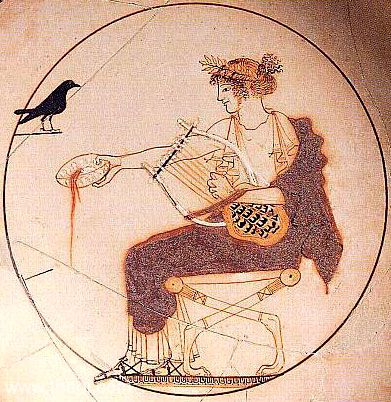
Apollo, god of music, Athenian red-figure kylix
C5th B.C., Archaeological Museum of Delphi
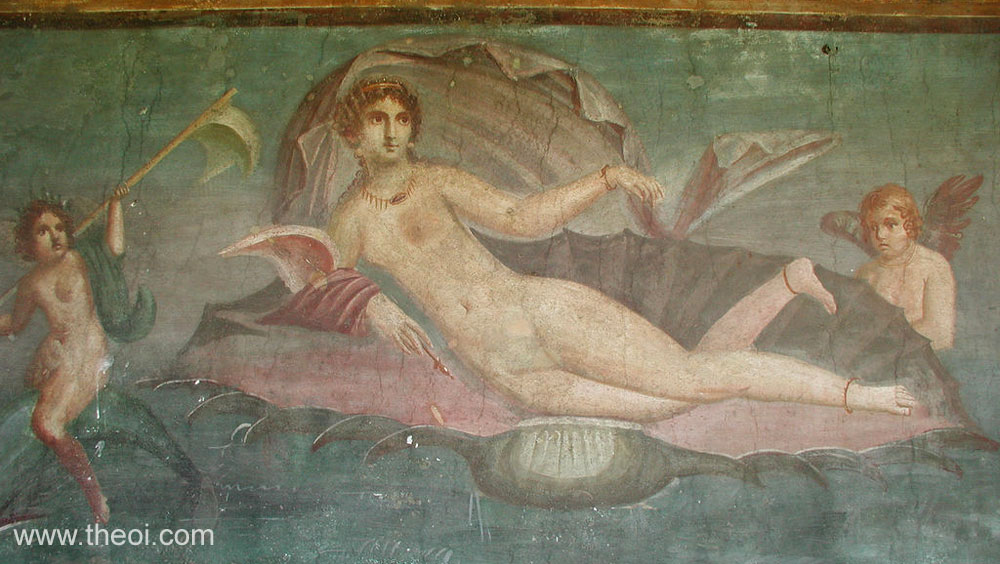
Aphrodite (Venus), goddess of love, Roman fresco from
Pompeii C1st A.D., Archaeological Museum of Naples
Argos:During the 7th century BC, at the times of the tyrant Pheidon, who introduced weights and measures in Peloponnese and according to Aristotle he invented coinage, Argos reached its highest power.
Mykenae: Founded by the hero Perseus and becoming favorite residence of Pelops and his descendants, it became the most important city of Greece at the times of the king Agamemnon.
Delphi: During the 7th century BC, when the barbarian cult of Dionysos had been introduced in Greece, endangering to wipe out the values and traditions and send Hellenes in barbaric stages, it was Delphi that saved Greece by ingeniously introducing Dionysos, with the qualities of Apollo.
Olympia: Every four years a pan-Hellenic truce was announced and people from all over Hellas gathered at Olympia, in order to compete and attend the Games. The prize for the winner was the "kotinos", a garland made from wild olive tree.
In Greece the language they speak is Greek, obviously, but there were some folk that didn't speak the native language and these people were known as Barbarians because they sounded like sheep - In Medea in the opening sequence there reads the line "Anywhere else you're a foreigner" which suggests that Medea is a foreigner and is a barbarian.
The Greek War of Independence, also known as the Greek Revolutionwas a successful war of independence waged by the Greek revolutionaries between 1821 and 1832, with later assistance from Russia, the United Kingdom, France, and several other European powers against the Ottoman Empire, who were assisted by their vassals, the Eyalet of Egypt, and partly by the Beylik of Tunis.
After the war the Greeks put on plays about peace and wealth and used these as themes to bring back the peace and wealth suffered from the war in their country.
The Pythia, commonly known as the Oracle of Delphi, was the priestess at the Temple of Apollo at Delphi, located on the slopes of Mount Parnassus, beneath the Castalian Spring. The Oracle was always half-baked and was corrupt, promising local citizens their most desired wishes taking their money and never doing as they asked.
Greek Theatre vocabularySkene - Scene/Background
Proskenion - Stage
Hypocrite - Actor
Orchestra - Dancing place
Katharsis - The purification and the purgation of emotions especially pity and fear through art
Choregos - Wealthy producerof the play
ThemesRevenge
Women
Foreigner
Apollo, god of music, Athenian red-figure kylix
C5th B.C., Archaeological Museum of Delphi
Aphrodite (Venus), goddess of love, Roman fresco from
Pompeii C1st A.D., Archaeological Museum of Naples

No comments:
Post a Comment